Omni Design System for Cross-Platform Consistency
As products expanded across XR, web, and mobile, maintaining consistency became increasingly complex.
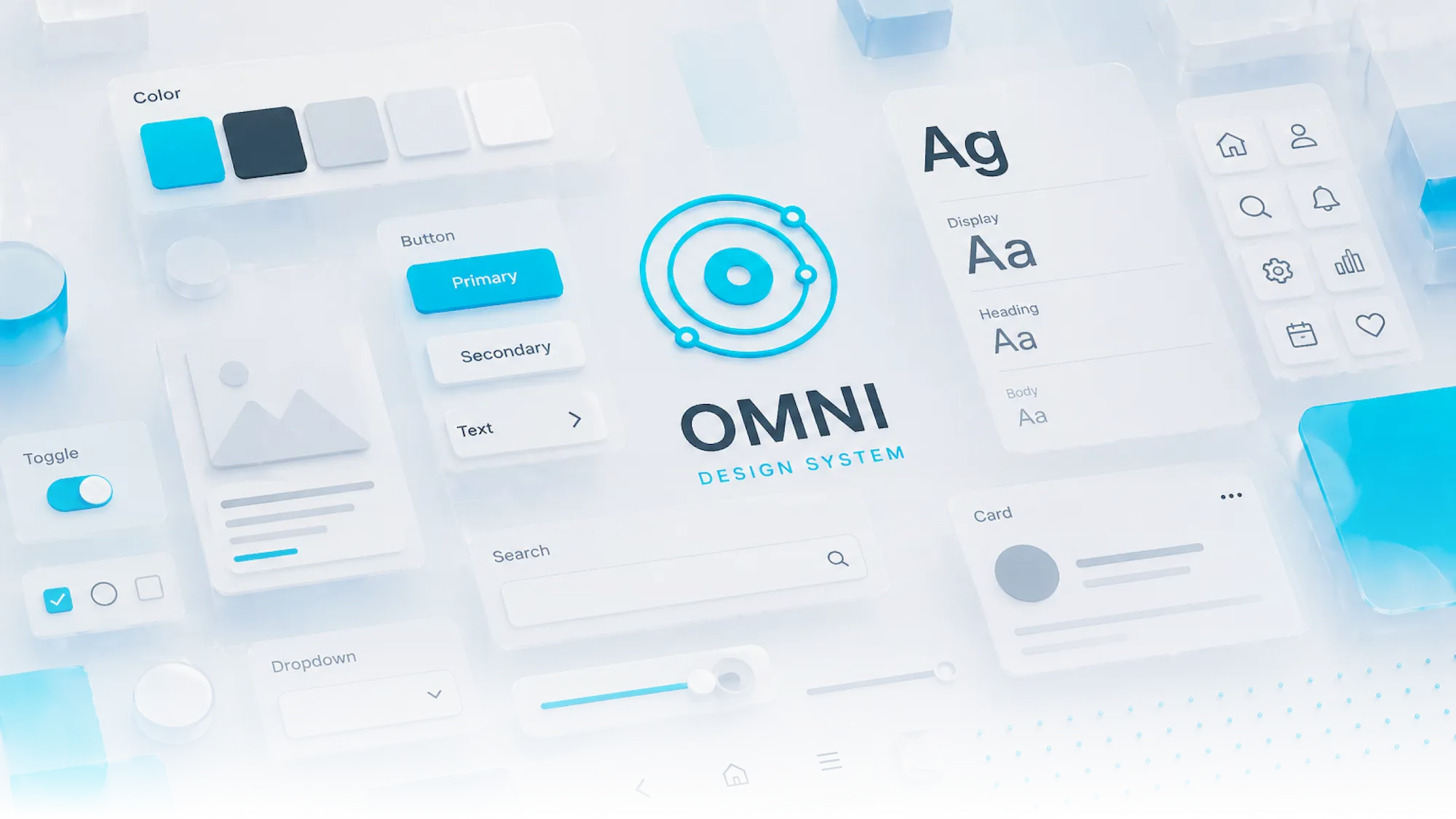
Omni is a cross-platform design system spanning VR, MR, and 2D products, evolving as both technology and organization grew.
It expanded from foundational assets into a scalable system supporting diverse interaction models, products, and team workflows.
I contributed from early foundations and later drove its evolution — shaping Omni into a cohesive system enabling cross-product consistency and long-term scalability.
Duration
2018-2025
Platform
XR (VR / MR), Web, Mobile, PC
Context
Between 2016–2018, VIVE expanded into a multi-surface ecosystem across VR, PC, Web, and Mobile.
Each surface evolved independently — without shared foundations, tools, or patterns.
This became the beginning of Omni.
Without a unified system, each platform evolved independently — fragmenting the experience across the ecosystem.
When VIVE launched its first VR device in 2016, the end-to-end experience extended across VR, PC, Web, and Mobile surfaces. Yet each surface was designed in isolation, using different tools and patterns, without a shared library or system connecting them.
This resulted in recurring challenges across teams:
Manual updates were required whenever UI changed
VR and 2D UI lived in separate tools with no shared assets
Icons and components were duplicated across products
Interaction patterns diverged rapidly
Designers and engineers repeatedly rebuilt similar UI
This fragmentation became the catalyst for Omni 1.0.
My Role
Omni began as a collaboration across design teams in the US and Taiwan.
I joined early as a contributor, helping define foundational assets and align 2D and VR patterns — and grew into a system and creative leader, helping shape Omni’s direction.
As the system and organization evolved, my role expanded from building components to taking on system direction, and eventually into a stewardship role supporting Omni’s long-term evolution.
Contributor → System Lead → System Stewardship
Built foundations: color, typography, iconography, and early 2D/VR component systems.
Defined XR interaction architecture, multi-input patterns, and token-based system foundations.
Led system evolution across products — establishing governance, scaling adoption, and enabling cross-team collaboration.
Initiated Omni × AI exploration — connecting design systems with emerging AI workflows.
My role evolved from designing components to shaping systems — and directing how teams align, build, and scale coherent experiences.
Process
Omni 1.0: Foundations
Establishing a shared design language across VR and 2D (2018–2019)
Unified color system, typography, iconography
Shared Sketch UI library
Unity VR component set
Initial cross-team review workflow
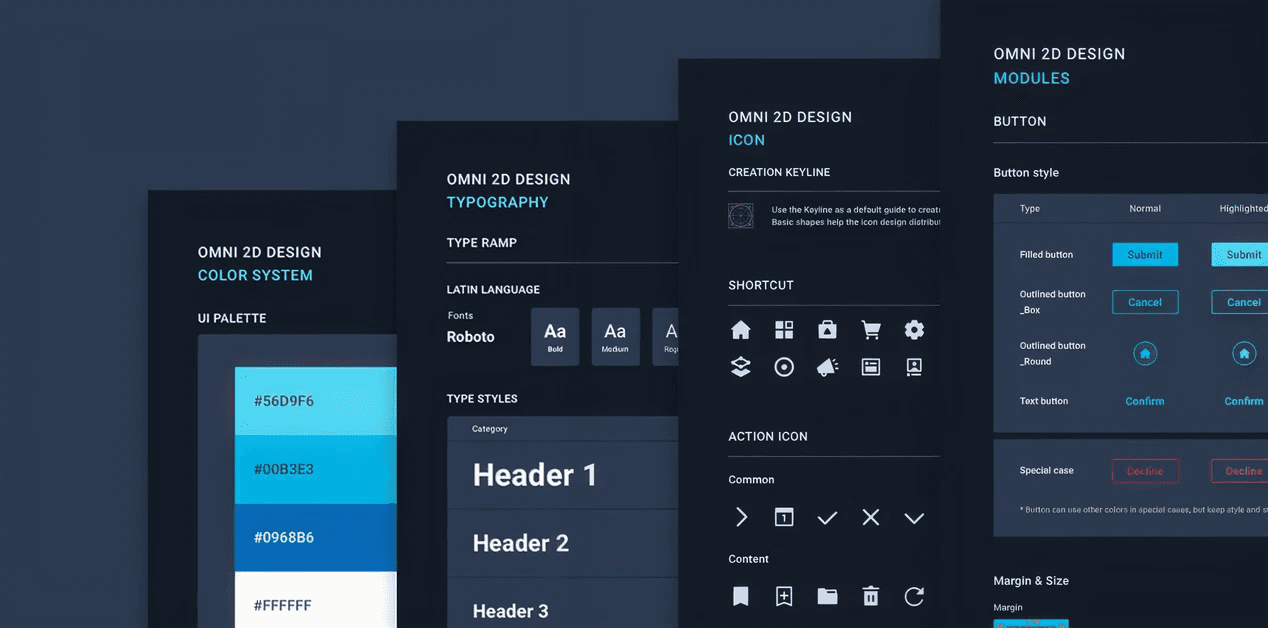
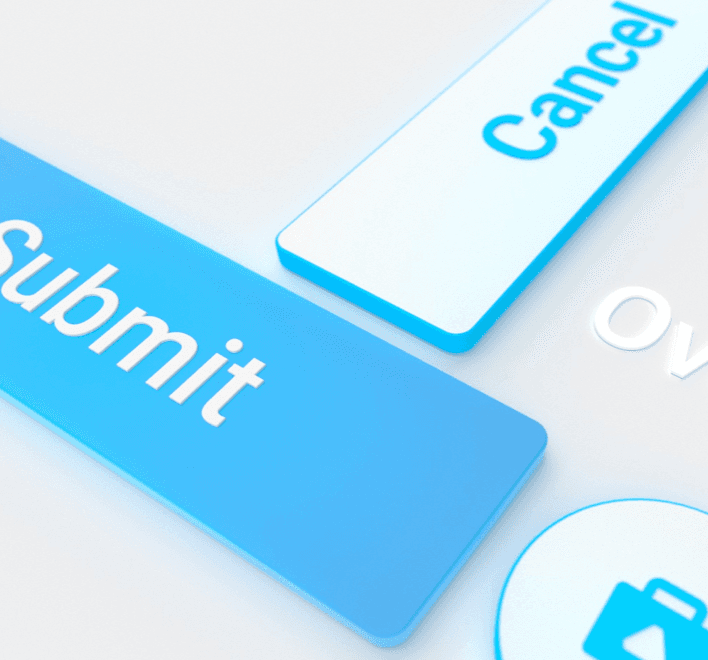
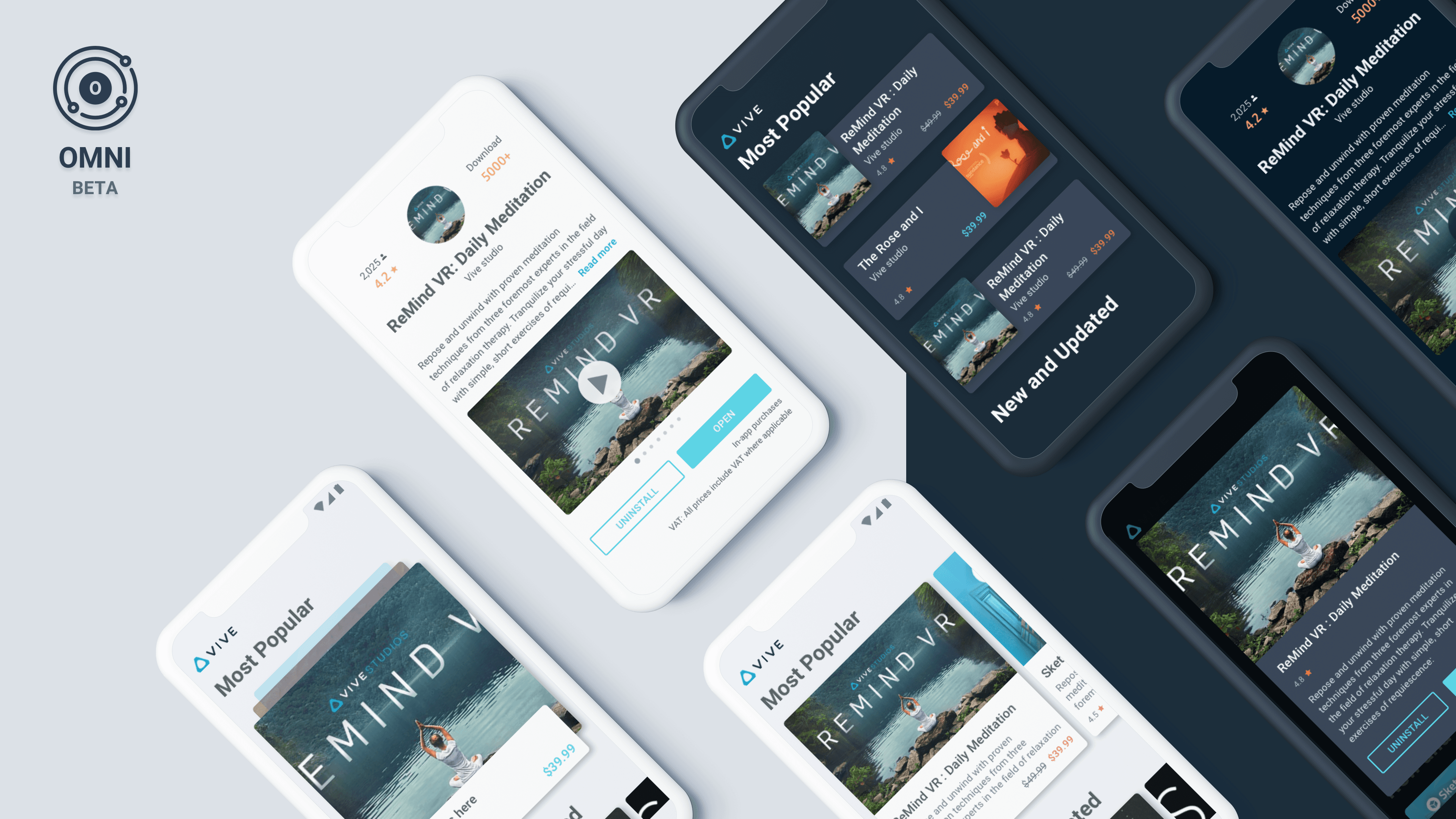
Establishing shared UI primitives across VR and 2D surfaces
Omni 2.0 — Scaling
Supporting multi-platform products and team adoption (2019–2021)
As VIVE evolved from PC VR to all-in-one (AIO) devices, the system needed to adapt to new constraints: lighter hardware performance, longer daily usage, and broader adoption in enterprise environments.
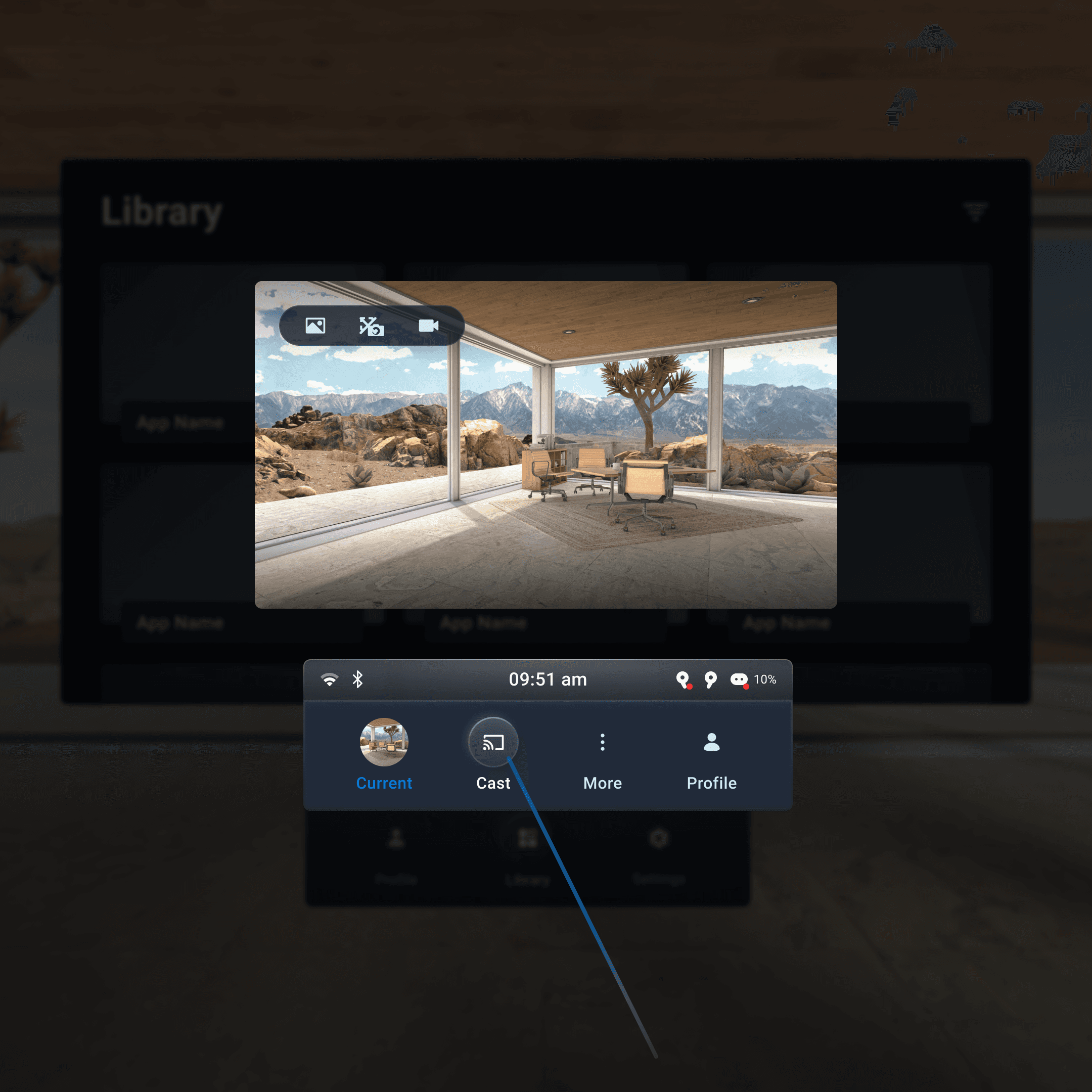
To support these shifts, we introduced a distance-based visual model that organizes UI layers around the user’s interaction space.
This reduced visual inconsistency across products and enabled teams to design for spatial contexts with a shared model.
Visual Language Evolution
Omni 2.0 introduced a lighter visual language using a 2.5D approach.
Rather than treating all interfaces as flat surfaces, the system organizes UI into three visual layers based on interaction distance:
Near zone : fully spatial 3D UI designed for direct interaction around the user
Mid zone : 2.5D overlays designed for spatial panels and system surfaces
Far zone : traditional 2D interfaces used across screens and dashboards
This layered approach preserves depth and hierarchy while reducing visual fatigue and maintaining clarity across different interaction distances.
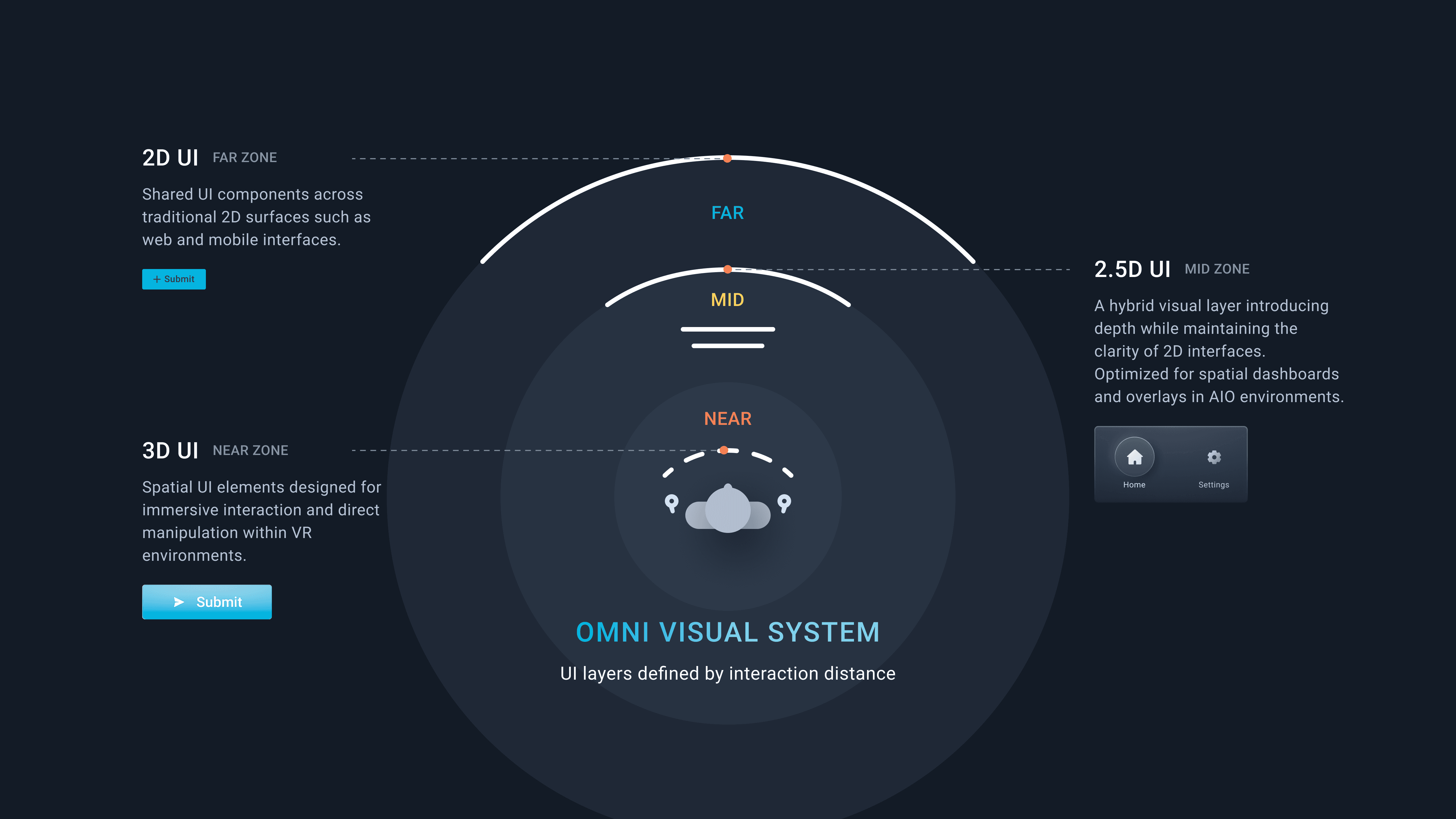
Omni 2.0 organizes UI into distance-based layers, allowing the system to adapt visual depth and interaction patterns across XR environments
Theme & Color System Expansion
A key shift in Omni 2.0 was the introduction of a theme-ready color system.
Primary (accent) colors were redefined at a system level, enabling global replacement through shared color definitions. This allowed enterprise clients to adopt their own brand colors without fragmenting the design system or redesigning individual components.
System Impact
Enabled scalable brand customization for B2B use cases
Maintained consistency across VR, PC, Web, and Mobile
Prepared the foundation for future tokenization and system automation
Omni 2.0 marked the transition from visual consistency to system adaptability—ensuring the design system could evolve with both technology and business needs.
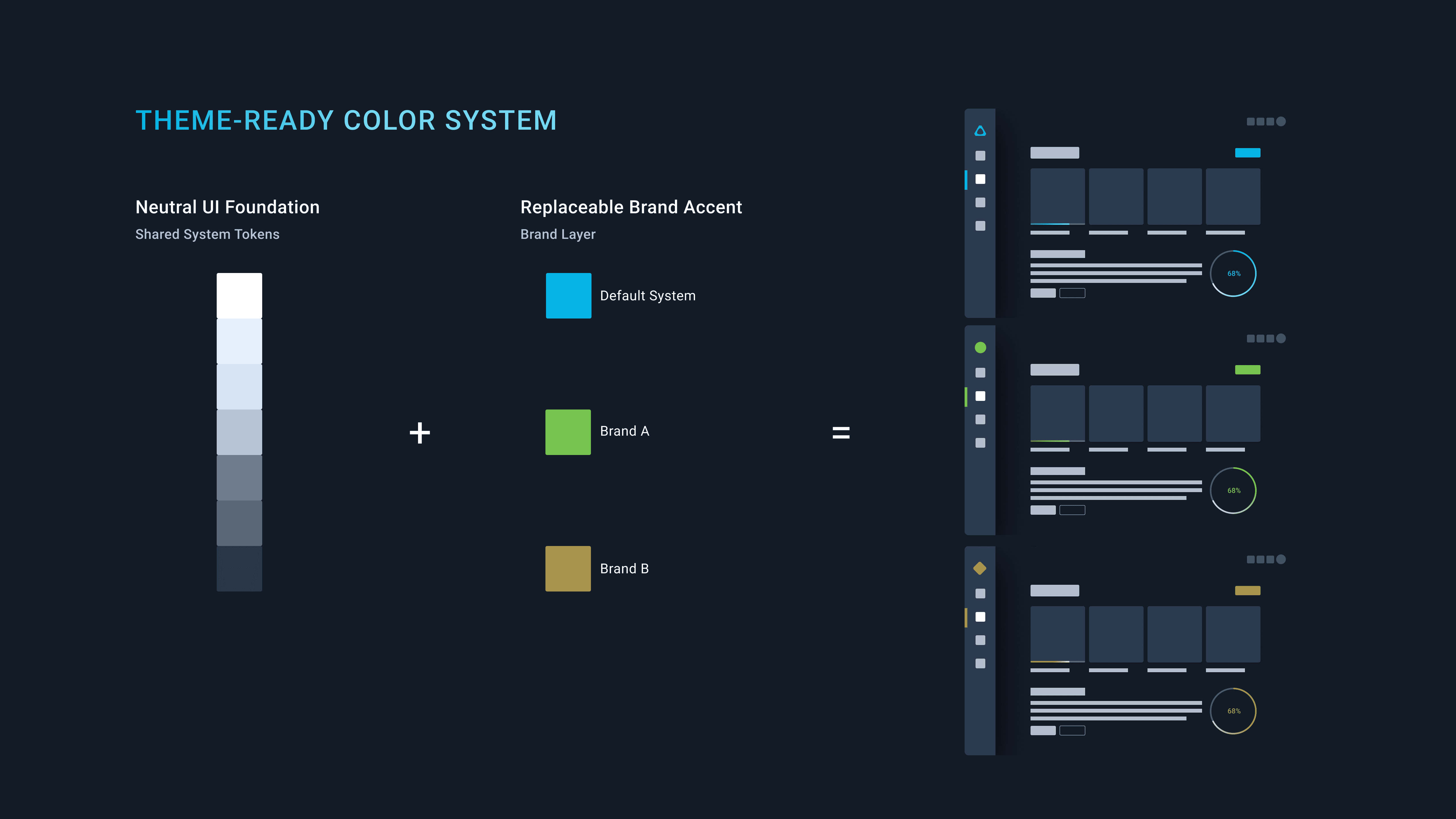
The color system separates neutral UI tokens from brand accent layers, enabling scalable theming across enterprise deployments
Transition — From Omni 2.0 to Omni 3.0
Omni 2.0 established a distance-based visual model and a theme-ready color system, enabling the design system to scale across devices, brands, and business contexts.
As XR hardware capabilities and product ambitions continued to evolve, new interaction challenges emerged. Experiences were no longer limited to single input methods or flat interfaces. Spatial environments required support for direct touch, eye tracking, controller input, and mixed reality scenarios.
These shifts introduced new design constraints that could not be addressed through visual language alone. A deeper interaction architecture was needed—one capable of defining consistent interaction patterns across devices, input modalities, and spatial contexts.
This led to the next evolution of Omni.
Omni 3.0 — Expansion
Adapting to new interaction paradigms and AI workflowsn (2021–2025)
Omni 3.0 expanded the system beyond visual language—introducing a unified interaction architecture, spatial ergonomics, and tokenized foundations designed for XR environments.
Interaction Model
Omni introduced a distance-based interaction model to unify interaction behaviors across XR devices.
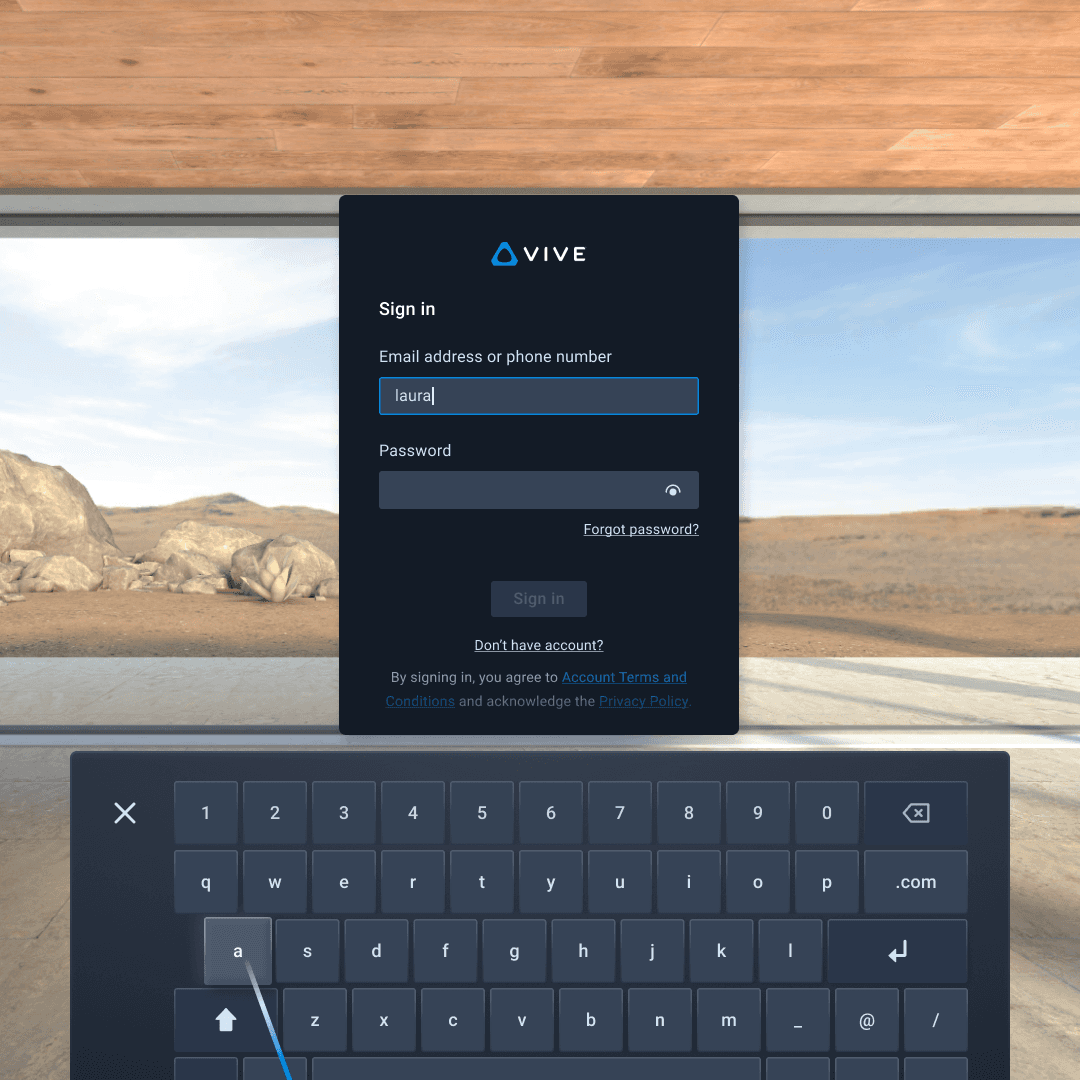
Near zone (0-0.4 m): direct touch
Mid zone (0.4-1 m): touch or ray-based interaction, gaze & pinch
Far zone (> 1 m): raycast, gaze & pinch
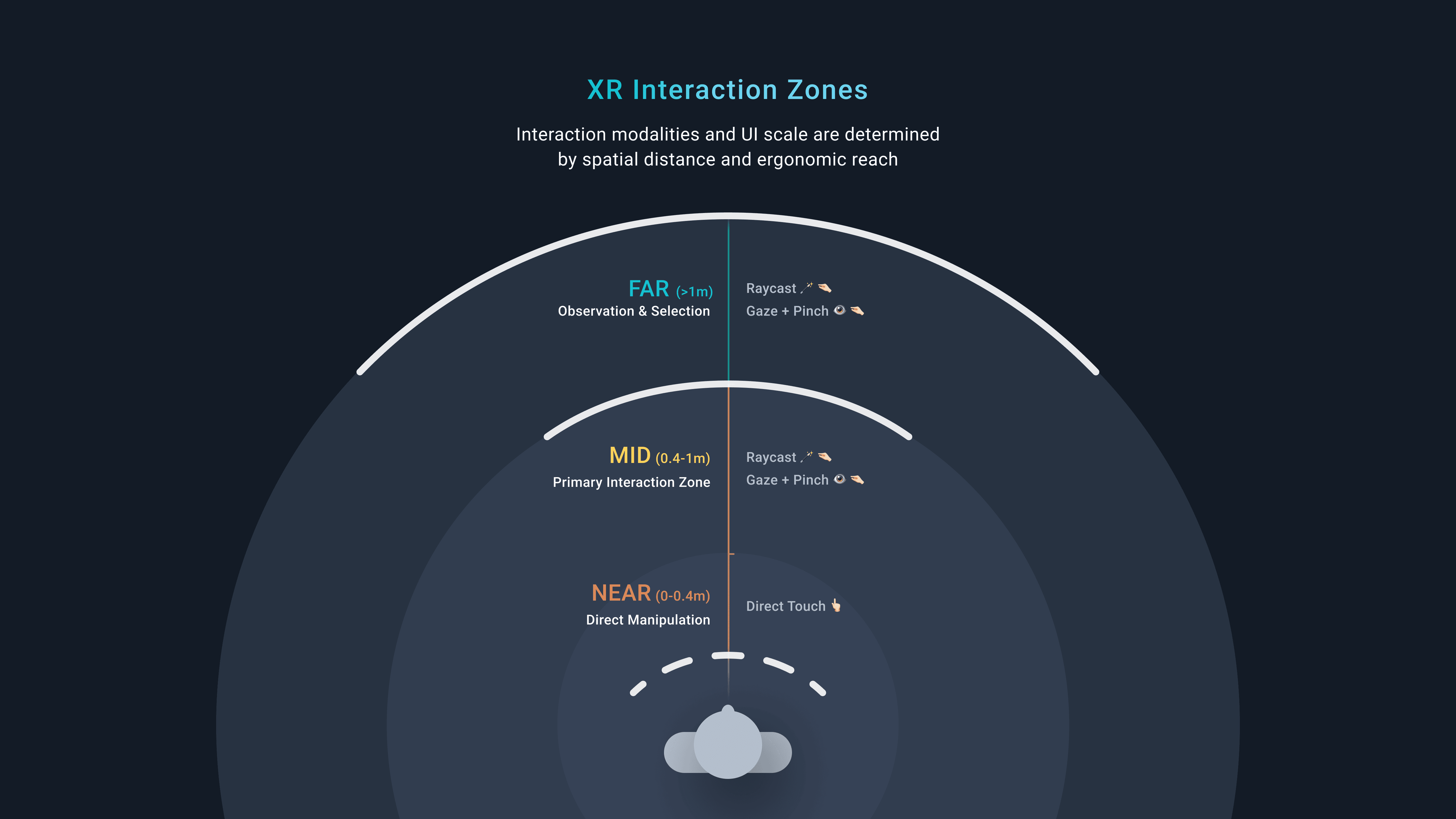
Omni unified interaction behavior across XR devices using a distance-based interaction model
Spatial Ergonomics
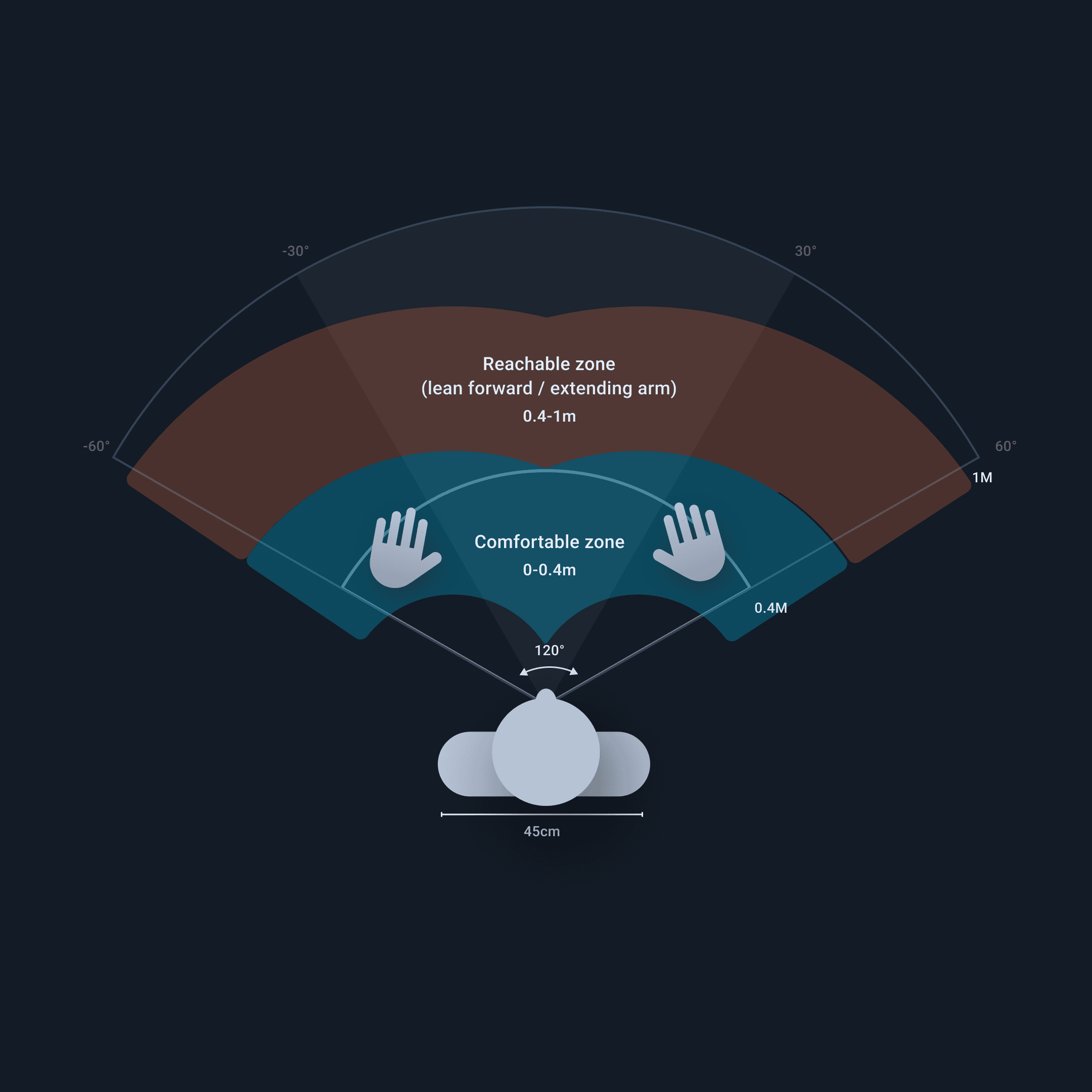
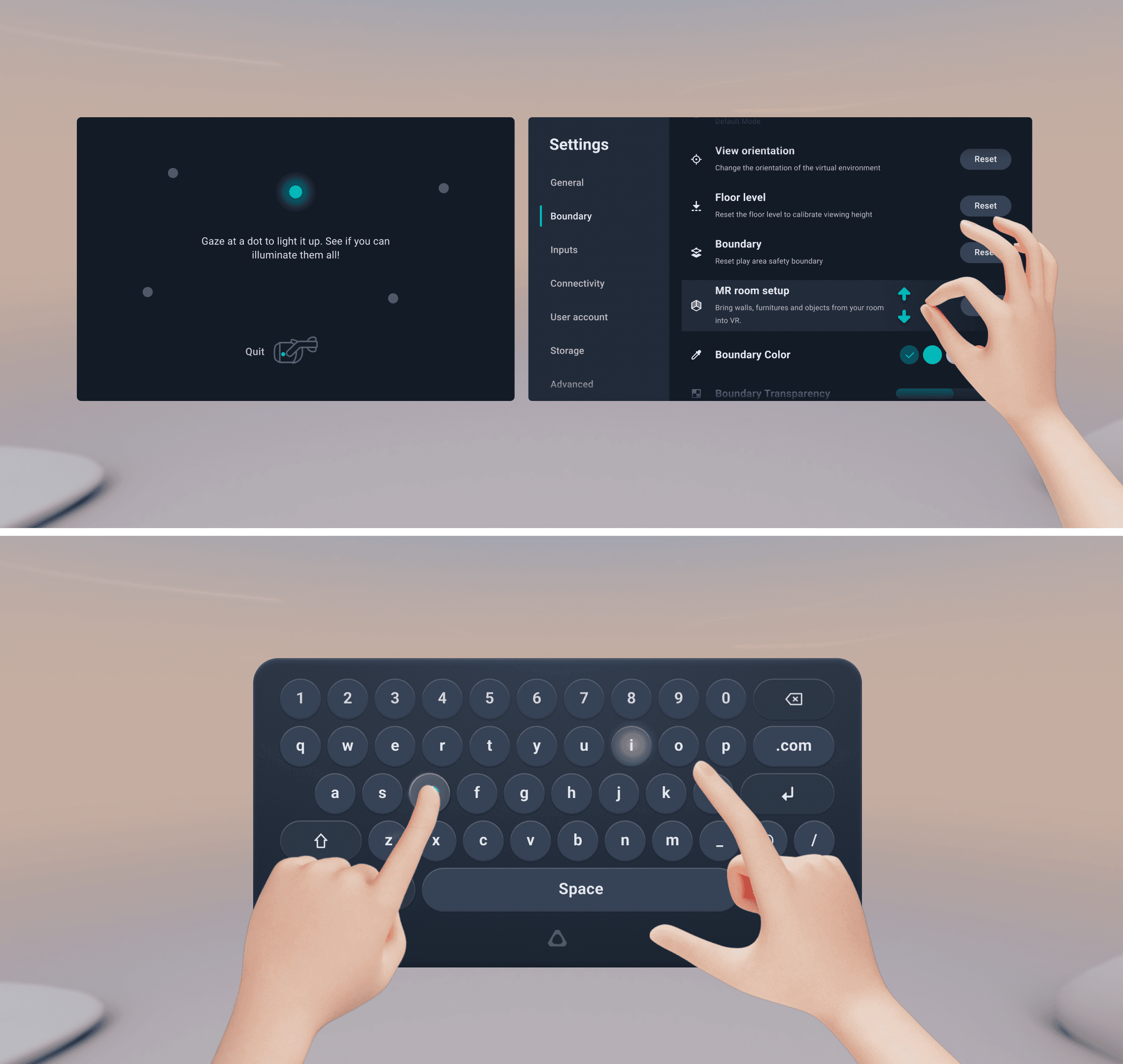
Interaction zones were supported by ergonomic guidelines to ensure comfort and readability in extended XR use.
Reach-based layout zones
Panel sizing based on distance & FOV
Minimum touch target 56 × 56 px at 1 m
Readability and comfort guidelines for extended use
MR-Ready Visual System
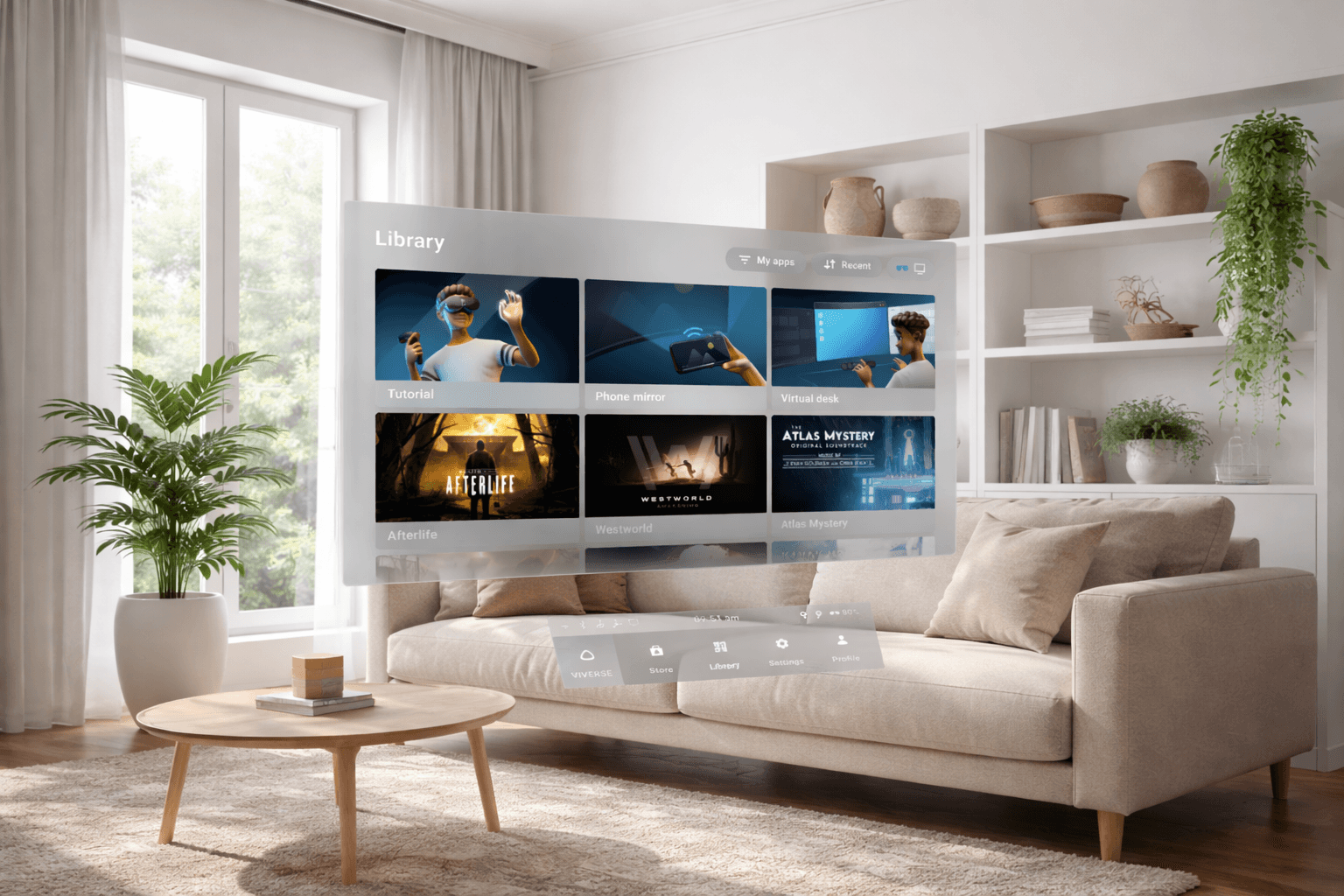
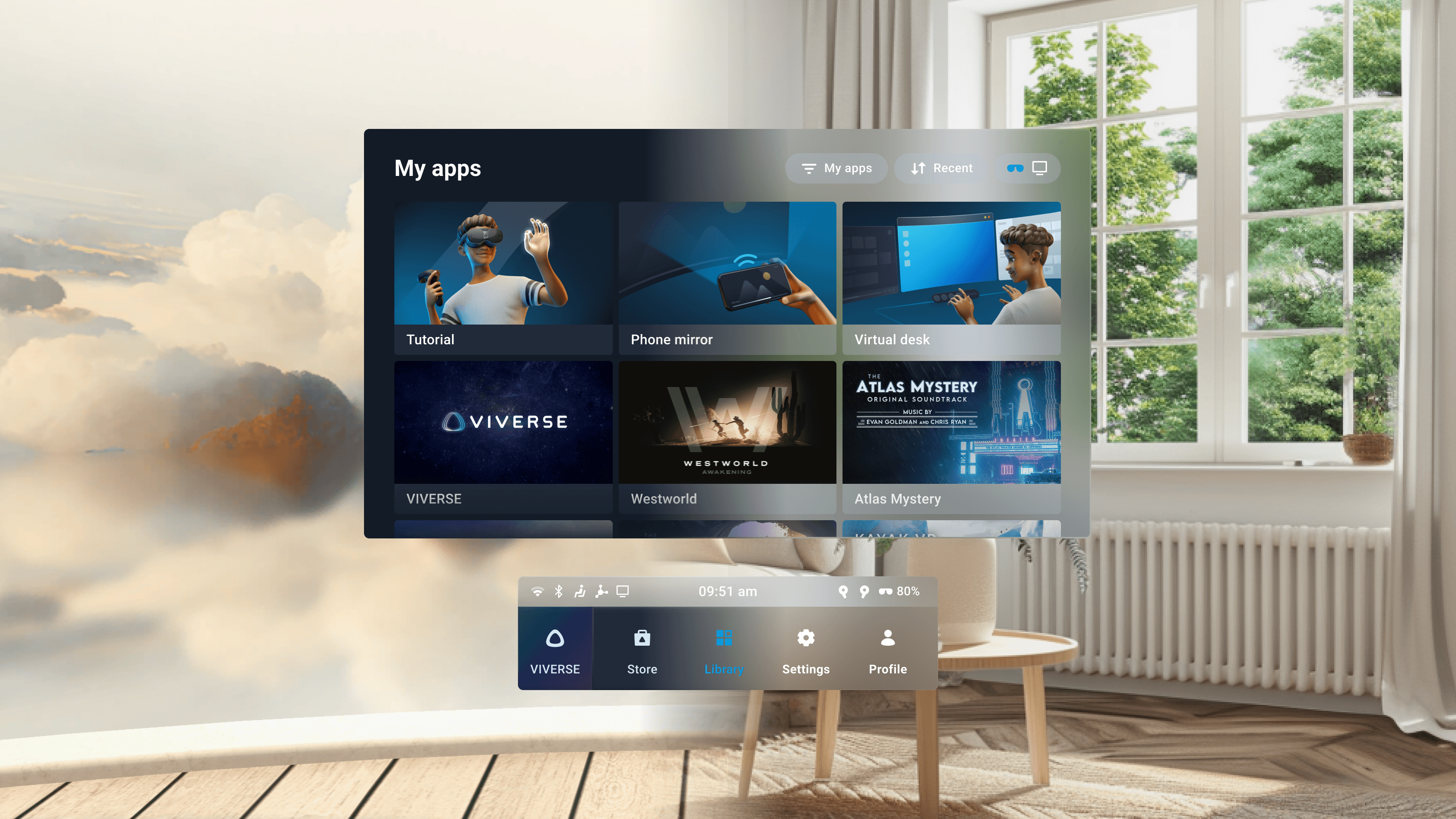
Transparent and glass-style UI layers
Depth layering with blur
Real-world contrast validation
System Infrastructure
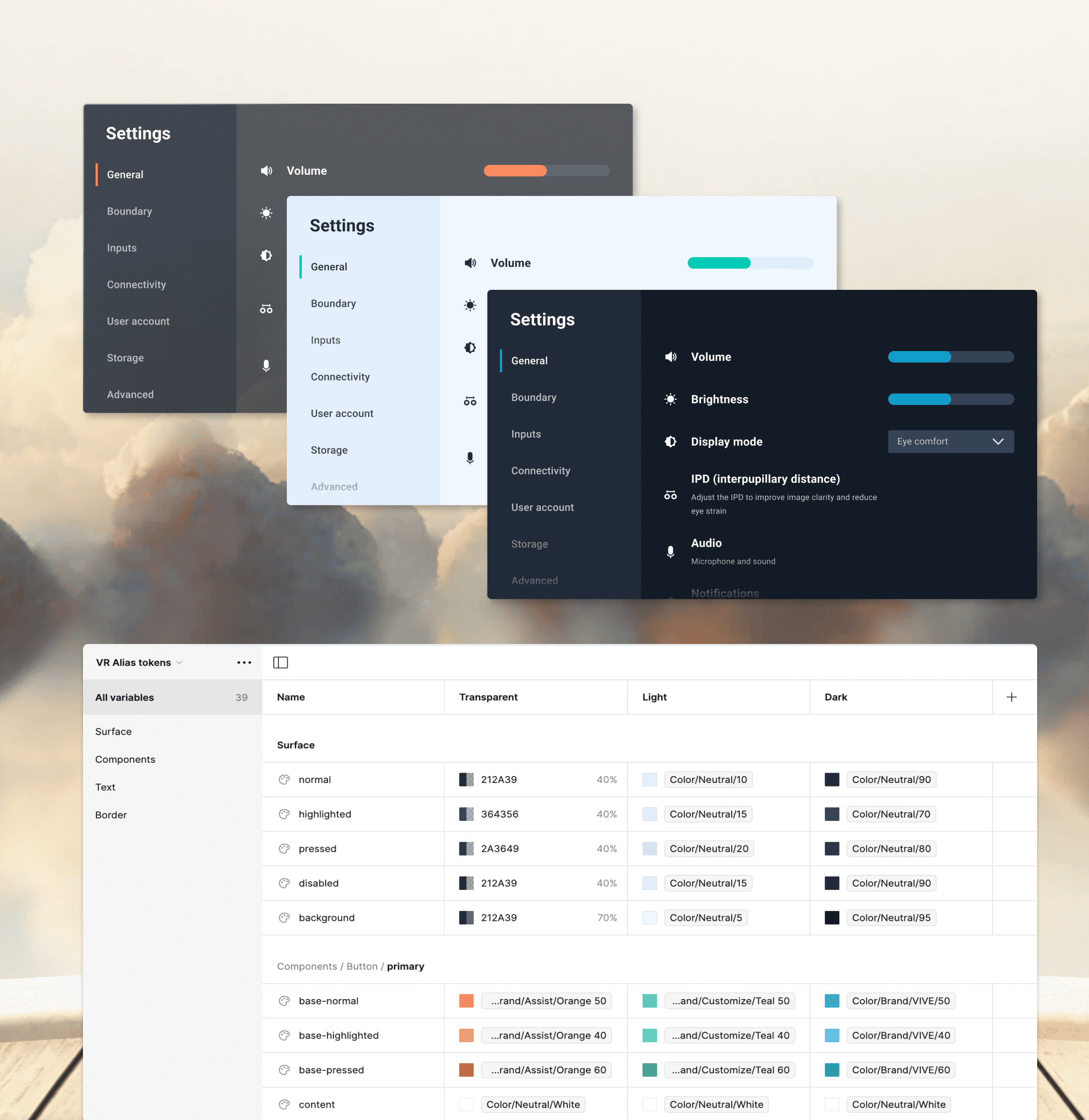
Tokenized foundations (color, radius, elevation, typography)
Multi-theme support
Shared semantics across VR and 2D kits
Dual-kit structure: VR spatial components, PC/Web/Mobile components
System Continuity
Omni 3.0 evolved alongside XR products and was continuously validated through real product implementation. Its application at runtime and system-level execution is detailed in Case 2: VRS.
Omni evolved through multiple phases — adapting to new platforms, interaction models, and organizational needs.
What remained constant was the need to keep the system coherent as everything around it changed.
Outcome & Impact
System coherence
Established shared design foundations that enabled consistent decision-making across regions and products, reducing divergence in UI patterns as the ecosystem expanded.
Collaboration at scale
Reduced duplicated design efforts and alignment overhead across teams, enabling faster iteration and more consistent cross-product experiences.
Durable foundations
Design foundations continued to be adopted across VIVERSE and the broader VIVE ecosystem, supporting new product directions without requiring teams to redefine core UI patterns.
Strategic resilience
Contributed to a resilient system architecture that allowed the platform to evolve alongside shifting product directions, without fragmenting user experience or design consistency.
Reflection
A design system is not just a library — it is the structure that enables teams to think, build, and evolve together.
As Omni matured, my focus shifted from building components to leading its evolution across the organization.
By establishing governance practices, evolving its architecture, and exploring how tokens and workflows could integrate with AI, my work became less about delivering components and more about strengthening the infrastructure that prepared both the system — and the teams behind it — for what comes next.