AI Workflow & Design Infrastructure for Scalable Creation
As AI entered the design process, workflows became faster — but less structured.
This work explores how AI can be integrated into design workflows as part of a system, not as isolated tools.
I led the definition of a design workflow where AI operates within design system constraints, enabling designers to generate, iterate, and prototype with structure and consistency.
This shifts design systems from static libraries into active infrastructure for scalable creation.
Duration
2023-2025
Platform
XR, Web, Mobile
Context
As XR systems became more coherent and scalable, a new bottleneck emerged — the process of creating content.
While interaction models had been unified, workflows for building scenes, tutorials, and experiences remained fragmented, manual, and difficult to scale.
Traditional workflows struggled to keep up:
3D scene creation required significant time and effort, with repeated manual work
Tutorial production involved long iteration cycles across UX, UI, and 3D teams
As platforms like VIVERSE emphasized content diversity and rapid iteration, existing design processes became bottlenecks
AI presented new opportunities — but only if treated as part of the system, integrated into design workflows and infrastructure rather than applied as isolated tools.
Generative AI accelerated creation — but design workflows were not built to support it.
As AI became more accessible, designers could rapidly generate layouts, visuals, and variations. However, without a shared framework, adoption often happened in isolated experiments — disconnected from design systems, UX principles, and product constraints.
This introduced new challenges across teams:
AI-generated outputs lacked consistency with existing design systems
Design quality became harder to control as iteration speed increased
Workflows diverged across tools instead of converging into shared processes
Designers spent more time refining and aligning outputs than expected
The role of designers became unclear in a “prompt-to-design” environment
The challenge was not adopting AI faster, but evolving workflows and roles — enabling AI to scale creativity without breaking systems or collaboration.
My Role
I led the exploration of AI-driven design workflows — shaping how AI could move from isolated tools into a scalable part of design infrastructure.
As the work evolved, my role focused on defining where AI adds meaningful value, structuring design system knowledge into AI-readable formats, and aligning emerging workflows with real product needs across VRS and VIVERSE.
Defined workflow goals and identified high-impact areas where AI could meaningfully reduce friction
Defined early frameworks for structuring design system knowledge into AI-readable formats
Led experimentation, tool evaluation, and iterative prototyping with cross-functional teams
Aligned AI workflows with real product scenarios — ensuring practical applicability beyond concepts
Facilitated discussions on evolving design roles and collaboration models in AI-driven workflows
While this work was highly collaborative, I focused on framing problems, shaping direction, and connecting system thinking with practical execution.
Process
AI as a Creative Partner
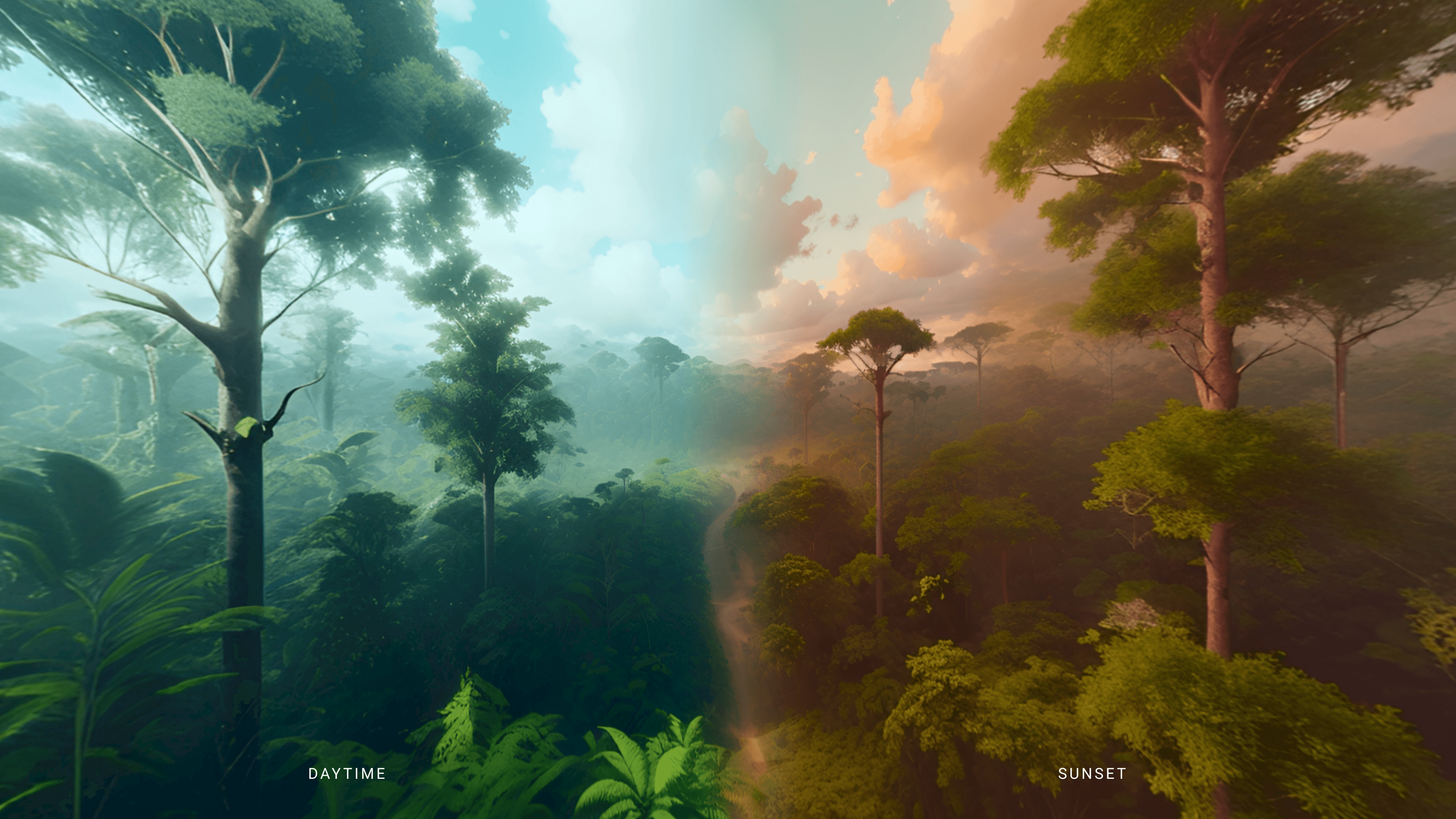
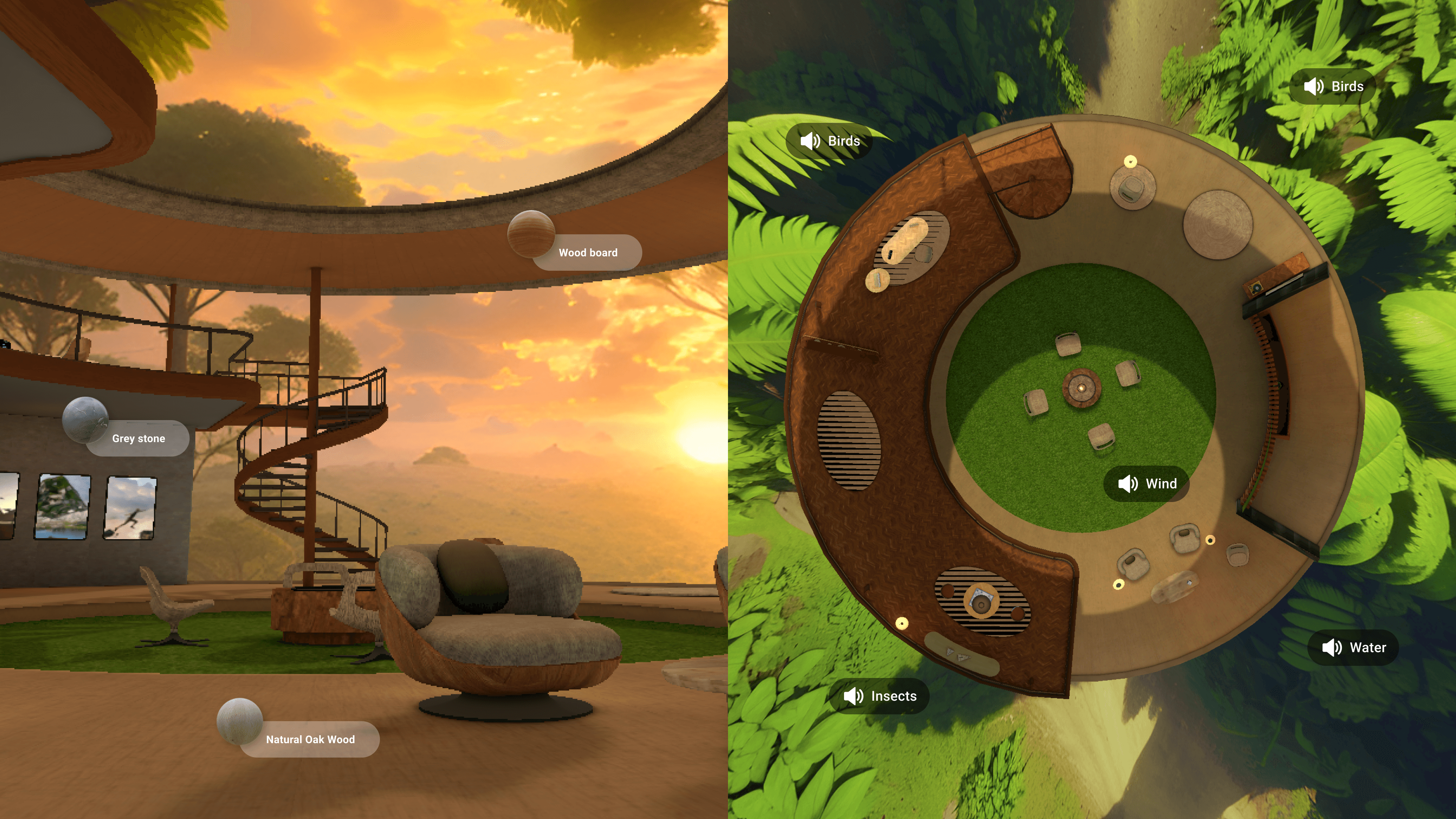
System-generated scene combining environment, dynamics, and spatial composition
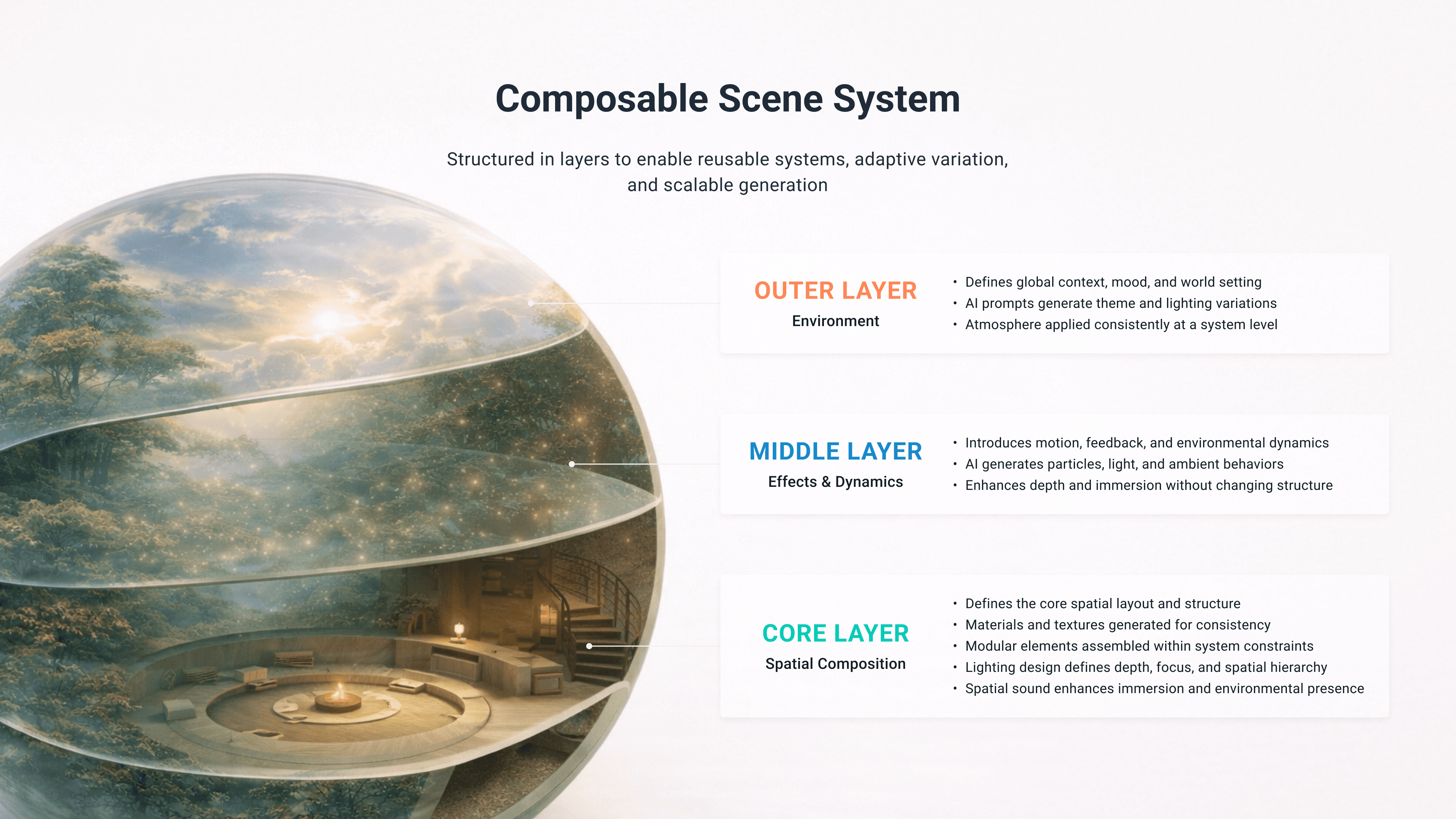
From product-driven insight to a structured scene design system
As XR products evolved, scene creation became increasingly repetitive and costly.
I introduced a systematic approach by decomposing environments into modular layers:
• Outer — atmosphere and mood
• Middle — motion and environmental dynamics
• Core — spatial composition, lighting, and sensory details
This established a reusable scene-level system, reducing redundant production effort and enabling consistency across scenes.
AI was introduced within this structure — supporting ideation, exploration, and early asset generation without breaking system coherence.
This approach was later validated in product (VIVE Focus Vision).
Key Shift
Scene design evolved from repeated production into a scalable system.
From product-driven insight to a structured scene design system
AI as a Workflow Accelerator
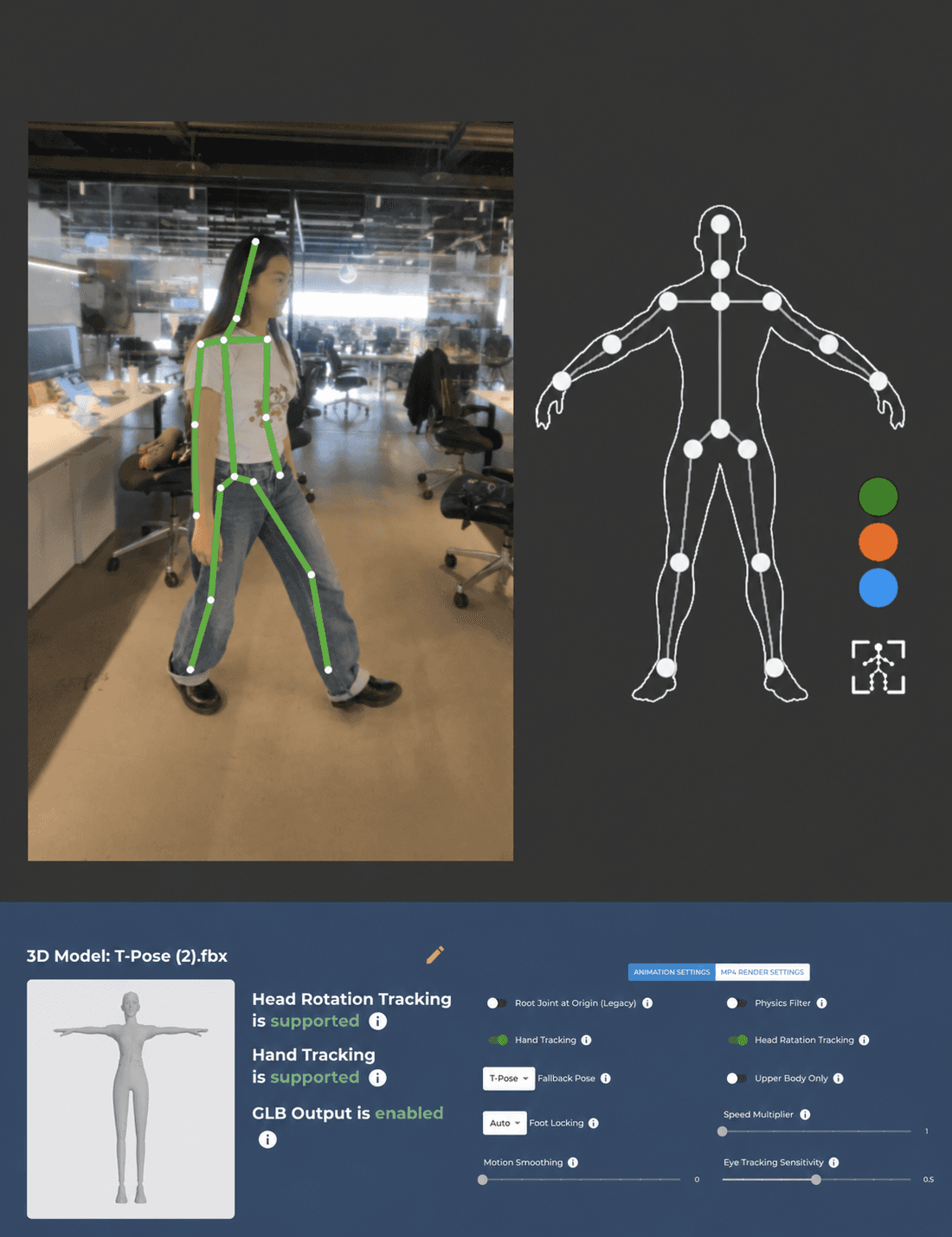
AI enables designers to validate motion and intent before 3D production
From system design to workflow transformation
As XR products expanded, tutorial content required frequent updates across devices, inputs, and interaction scenarios.
Previously, UX, UI, and 3D teams relied on iterative alignment—spending significant time refining animation before design review.
We introduced AI earlier in the workflow, enabling designers to validate motion and intent using generated animation before 3D production.
This shifted the workflow from production-first to validation-first.
From Iteration-Heavy to Validation-First
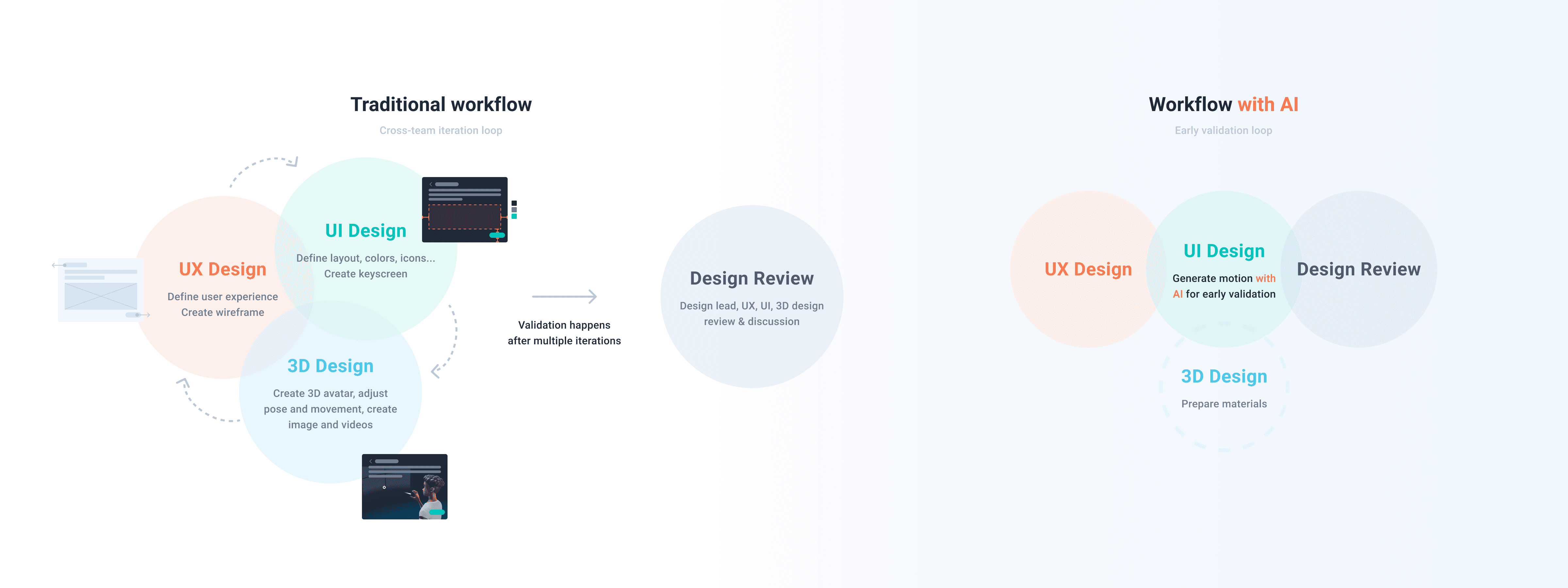
AI shifts validation upstream—transforming a production-heavy pipeline into a validation-first workflow
Key Shift
Validation shifts upstream—from post-production to pre-production
Iteration shifts from manual refinement to AI-assisted loops
Collaboration shifts from sequential handoffs to early alignment
Impact on 3D Production Workflow
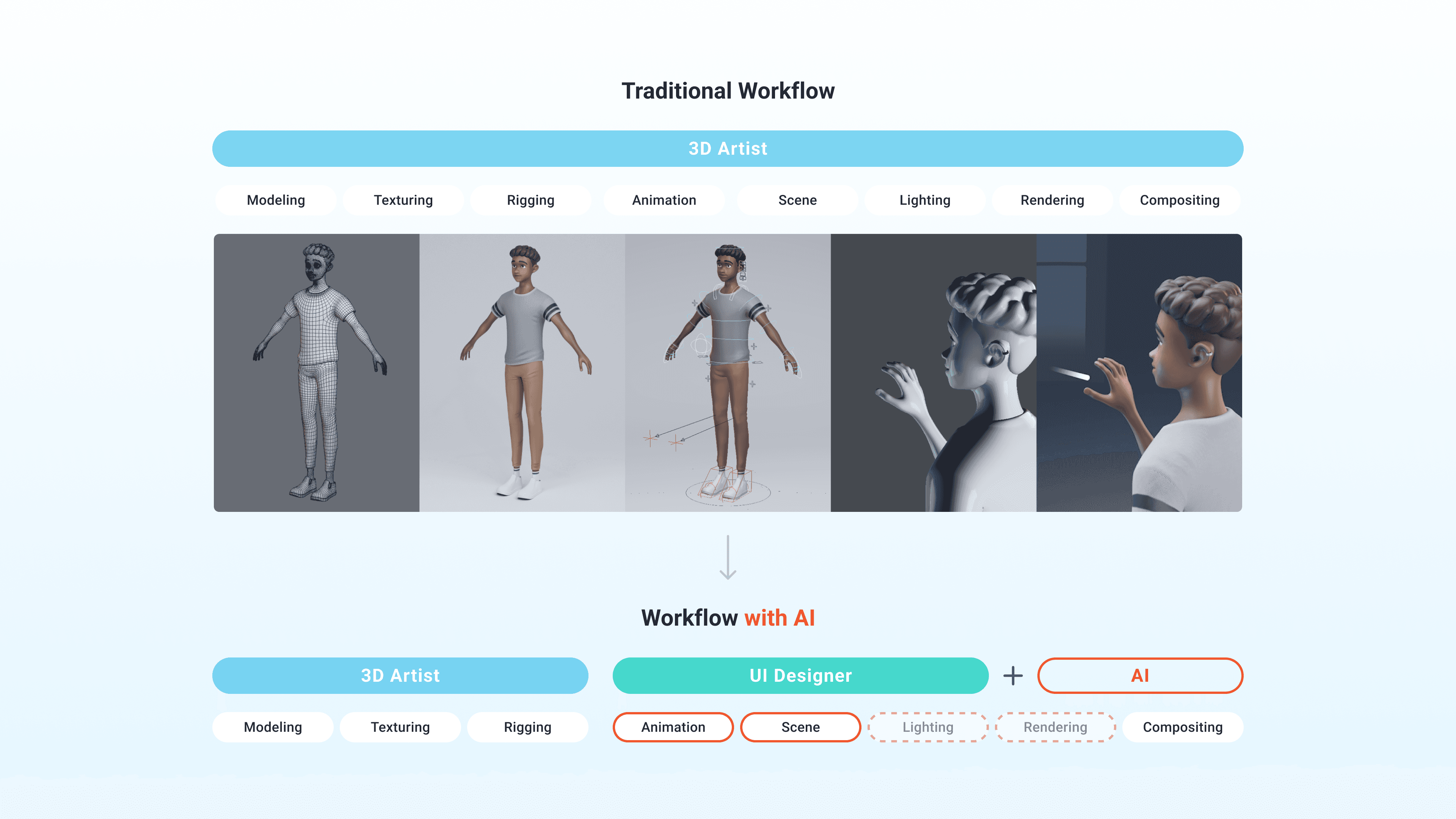
Validation moves earlier in the process—reducing iteration cost and enabling faster team alignment
Workflow Steps
AI shifts validation earlier—allowing teams to align on motion before investing in 3D production
From Workflow Optimization to System-Level Design
From workflow optimization to system-level scalability
AI is no longer just accelerating workflows—it is redefining how design is created, structured, and scaled.
Built on Omni’s tokenized foundation, AI generation becomes an extension of the design system—ensuring outputs remain consistent with system rules and visual language.
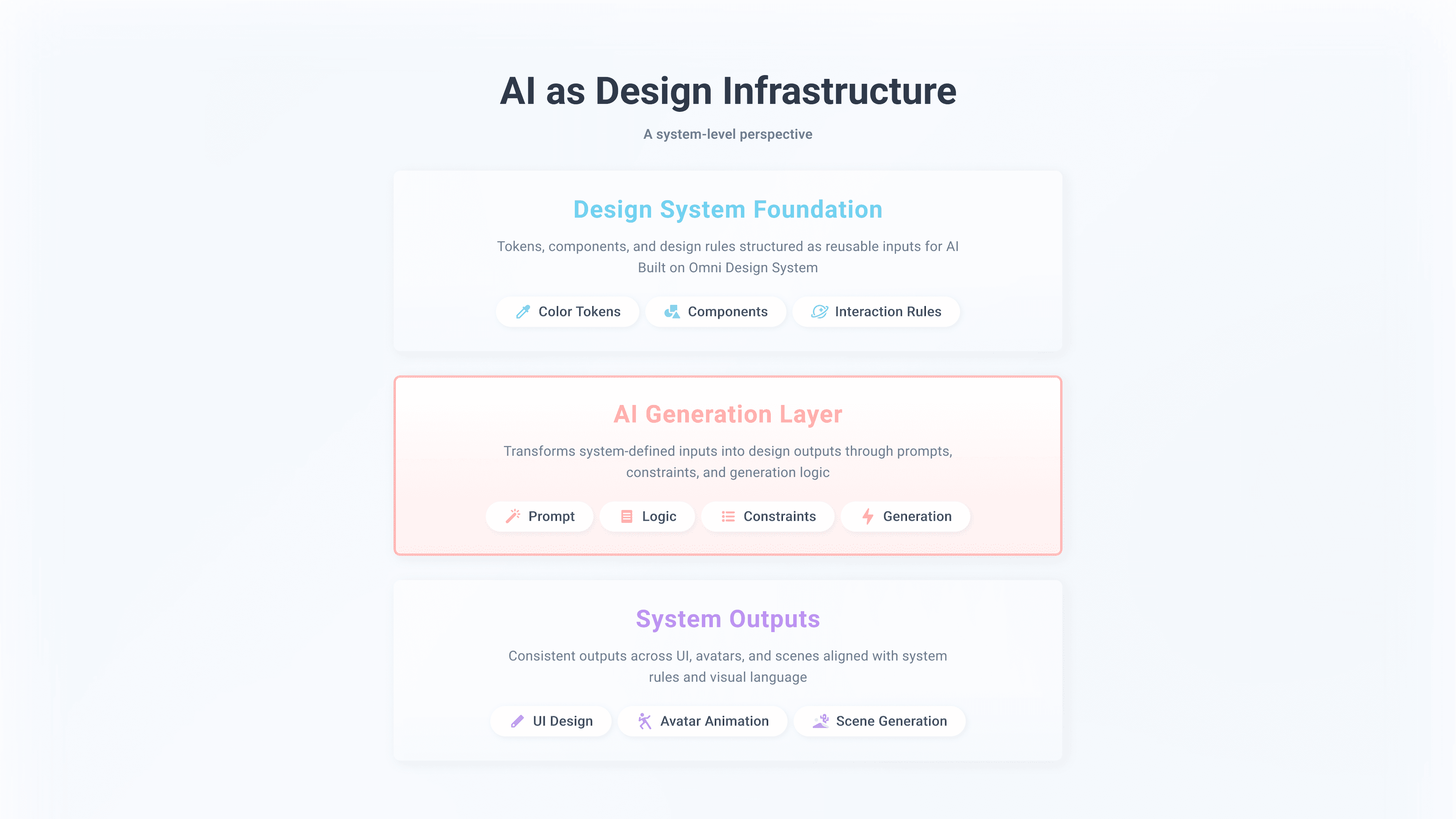
AI becomes a foundational layer—integrating design knowledge into the system itself
Bridging system definition and execution
With system-level intelligence in place, design creation becomes more structured, scalable, and less dependent on manual processes.
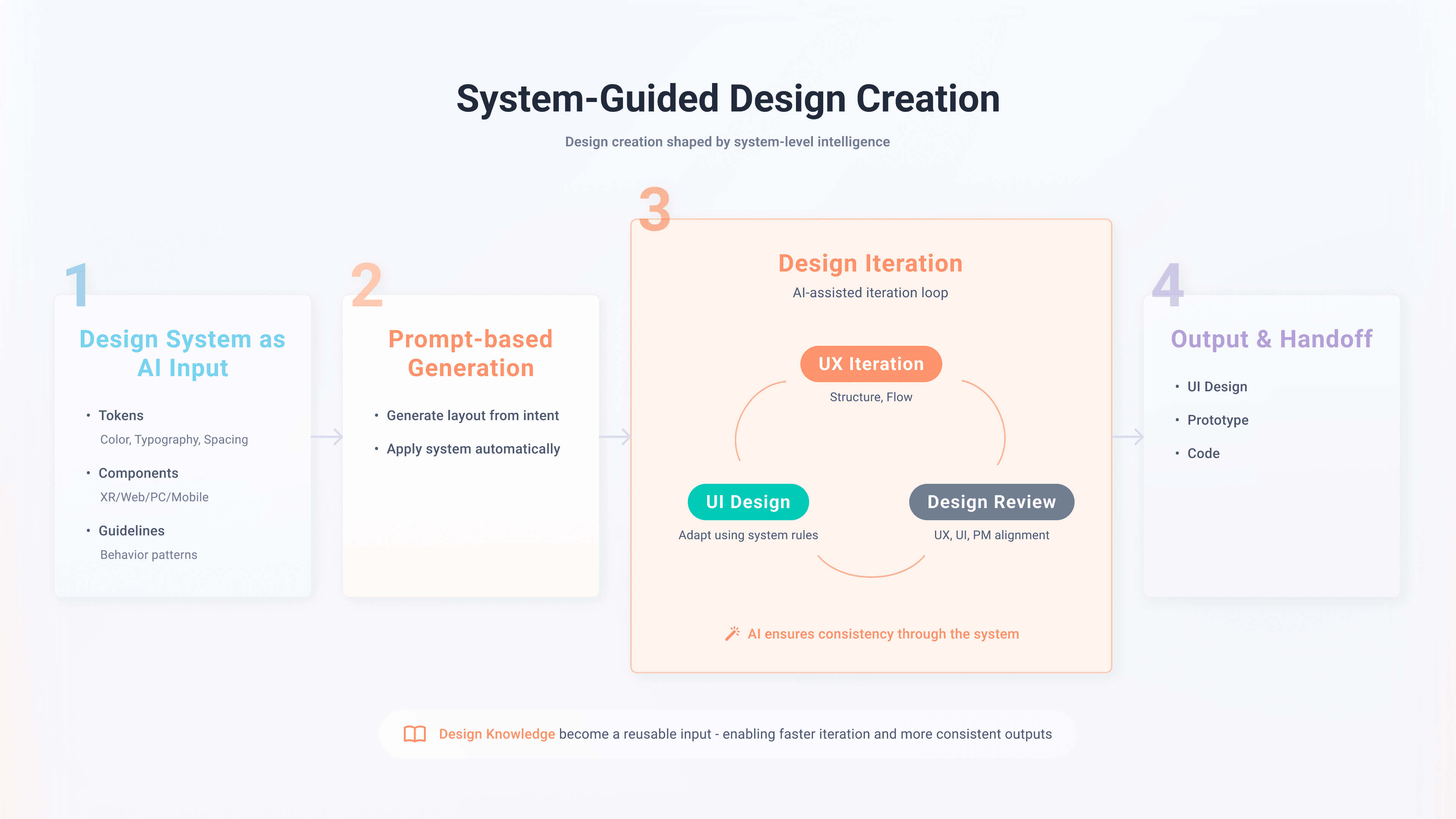
Design knowledge becomes executable—ensuring consistency at scale
As design creation evolves, collaboration fundamentally shifts
As AI becomes embedded in the system, it reshapes not only design creation—but also how designers collaborate.
The role of UX and UI designers shifted from sequential execution to shared, system-guided iteration.
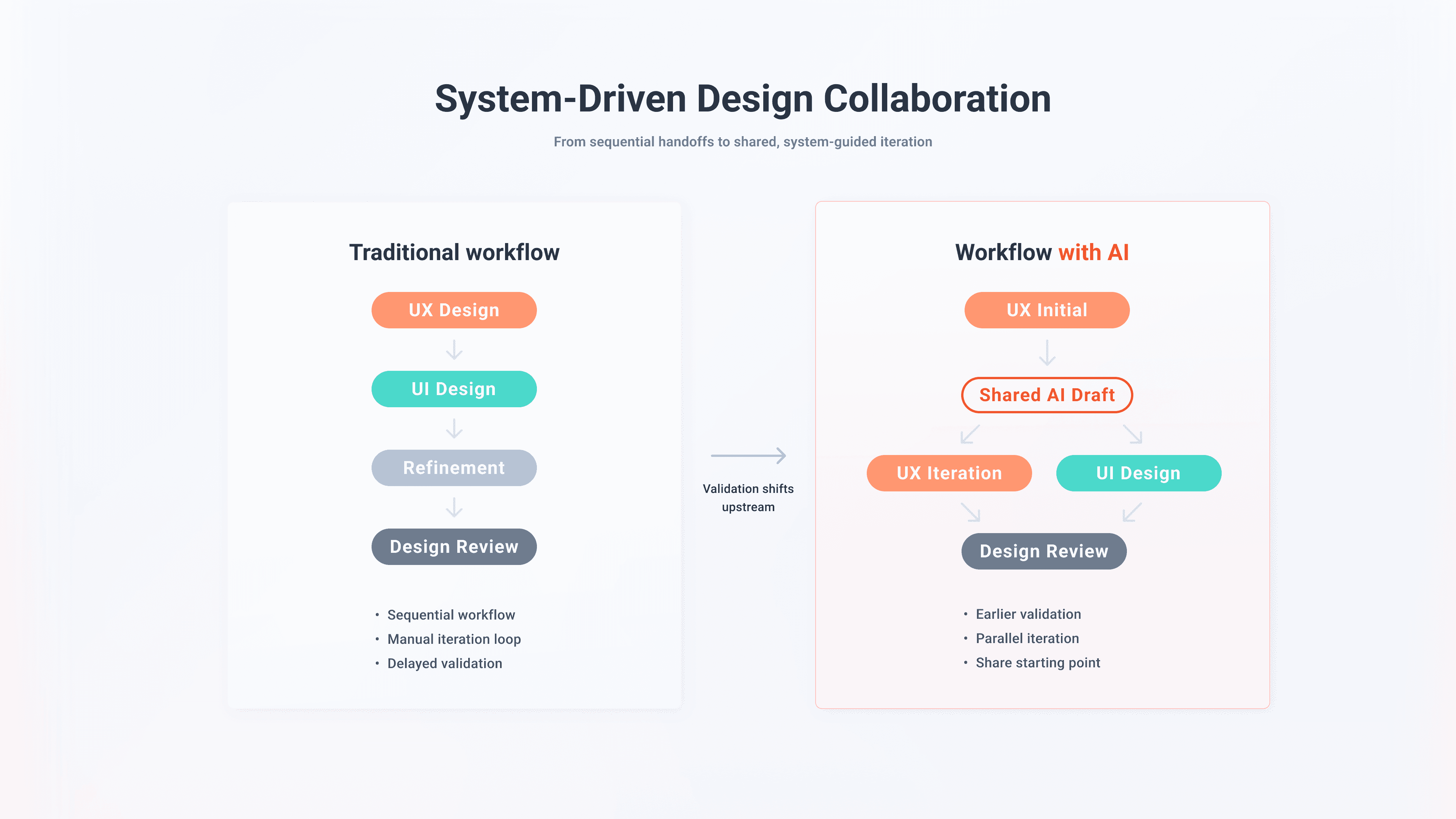
AI transforms collaboration from sequential handoffs to shared, system-driven iteration
Key shift
AI evolves from a workflow accelerator
into the system that defines how design is created.
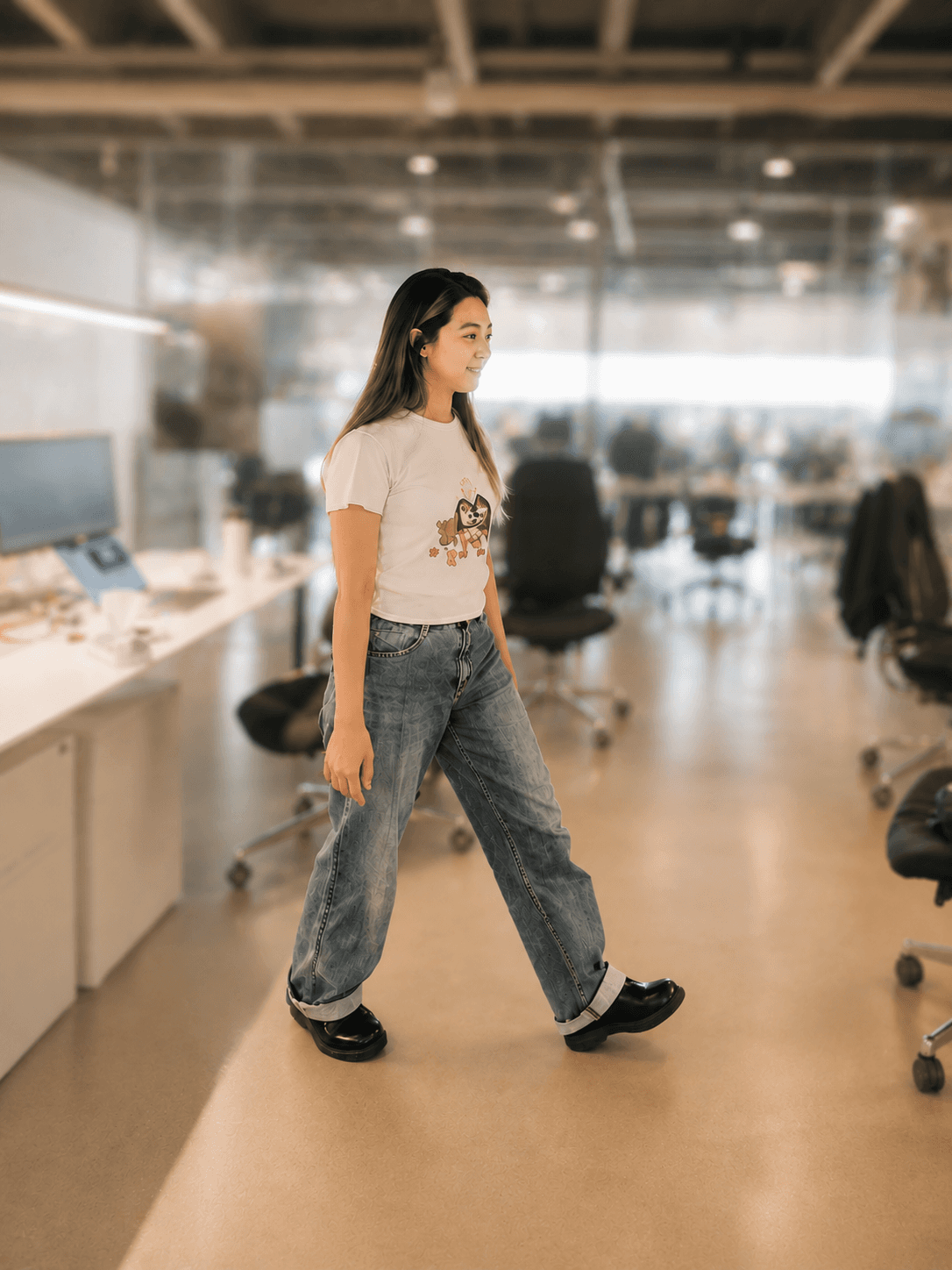
Application Example — VIVERSE Avatar Memoji Generation
As a concrete application of this approach, the same system was applied to VIVERSE Avatar Memoji generation.
By structuring style constraints, visual rules, and reusable assets as inputs, AI-assisted generation enabled diverse avatar expressions while maintaining consistency with brand identity and platform aesthetics.
Rather than a standalone feature, Memoji generation validated this system in practice—demonstrating how AI-guided creation, grounded in design systems, can scale across use cases while balancing creative flexibility and product consistency.
To enable consistent and scalable generation, the AI layer needed to be redefined—not as a tool, but as a structured system.
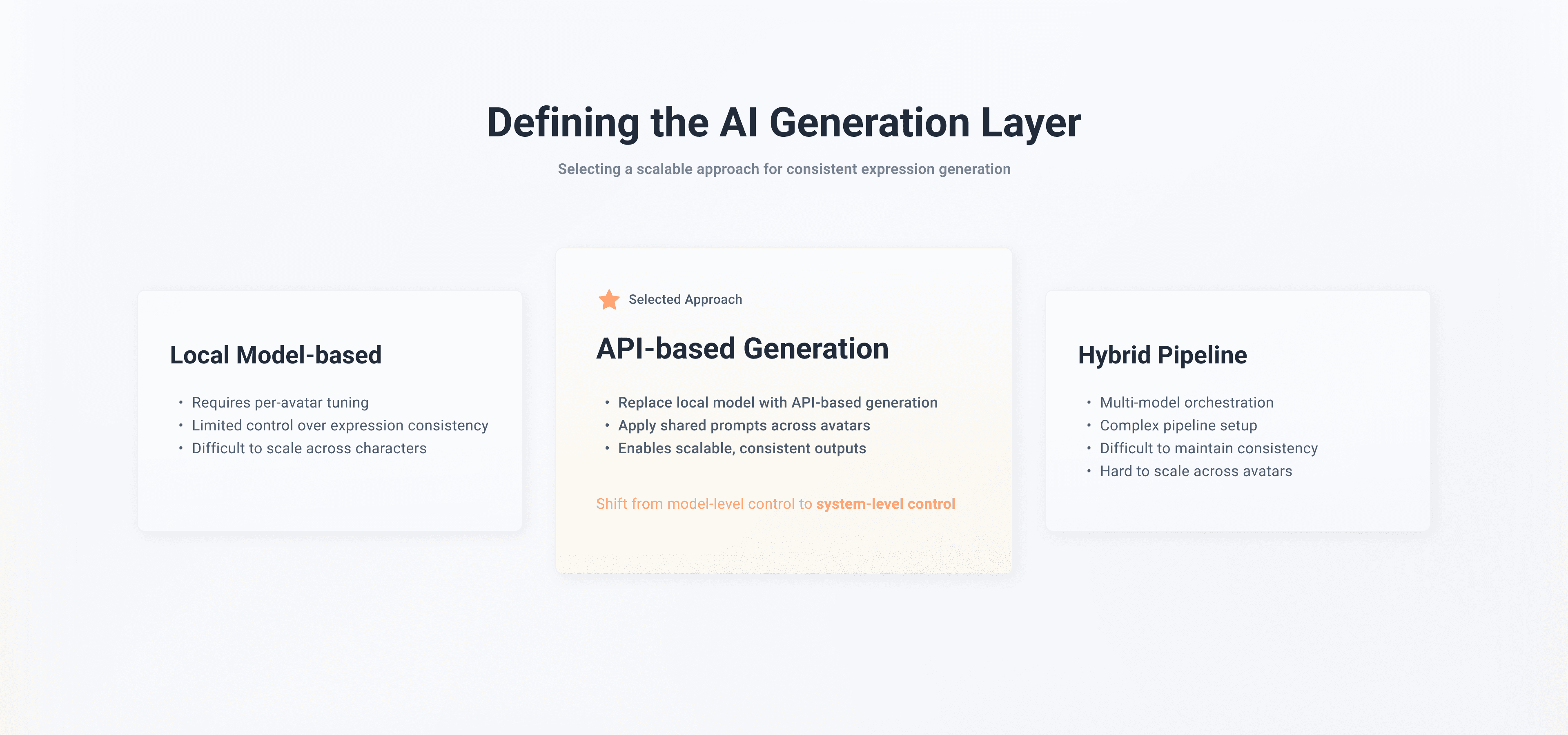
Early experiments revealed limitations in controlling expression consistency, leading to a shift toward API-based approaches for scalable generation
Rather than relying on a single tool, the focus shifted to structuring how inputs, constraints, and generation logic are defined and applied.
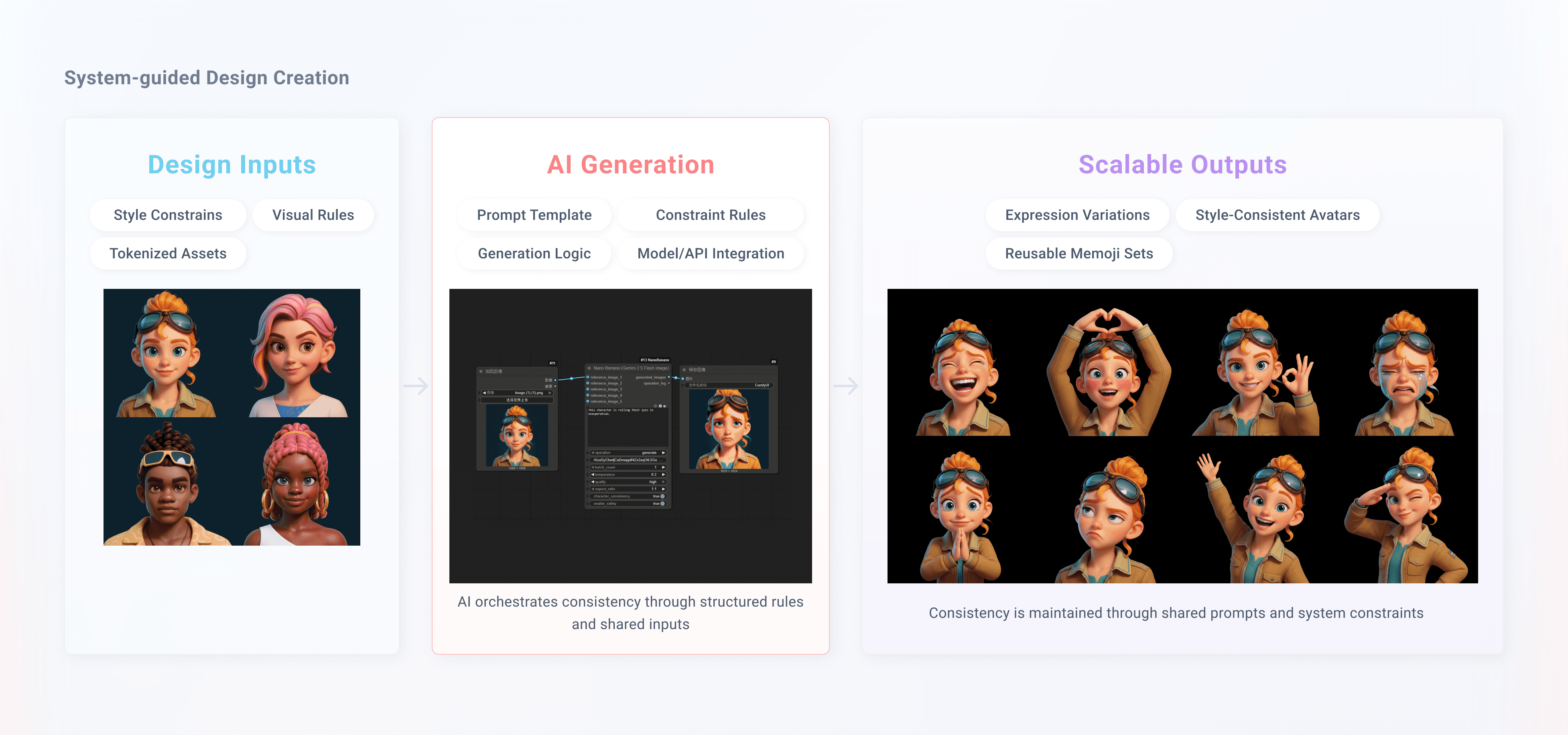
Design knowledge becomes a reusable input—enabling consistent and scalable Memoji generation
Outcome & Impact
This shift resulted in both operational and strategic impact:
Efficiency
Reduced manual effort and shortened iteration cycles across design creation.
Scalability
Established reusable, modular design structures across products and platforms.
Adoption
Transitioned AI workflows from experimentation into real product use.
Collaboration
Shifted design conversations from execution details toward system intent and quality.
Strategic value
Established AI as part of design infrastructure rather than isolated tools.
Reflection
AI clarified what should scale — and what should remain human.
Working with AI reshaped how I think about design — not as isolated outputs, but as systems that can be structured, extended, and integrated into workflows.
Rather than replacing design, AI revealed the importance of infrastructure — defining how knowledge, patterns, and decisions can scale while maintaining coherence.
This experience reinforced my belief that design is not replaced by AI, but redefined through systems.